
Hyundai Sonata LF: Evaporative Emission Control System / Repair procedures
| Inspection |
| 1. |
Disconnect the vapor hose from the intake manifold and connect a vacuum pump to the nipple on the intake manifold.
· At Cold Engine [Engine Coolant Temperature < 60°C(140°F)]
|
| 2. |
Check the following points with applied vacuum at the purge control solenoid valve (PCSV).
· At Warmed Engine [Engine Coolant Temperature > 80°C(176°F)]
|
| 1. |
Turn ignition switch OFF and disconnect the negative (-) battery cable. |
| 2. |
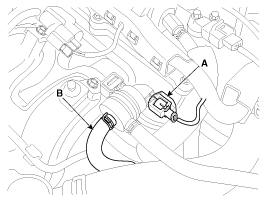
Disconnect the PCSV connector (A). |
| 3. |
Disconnect the vapor hose (B) which is connected to the intake manifold from the PCSV.
|
| 4. |
After connecting a vacuum pump to the nipple, apply vacuum. |
| 5. |
With the PCSV control line grounded, check the valve
operation with battery voltage applied to the PCSV(Open) and
removed(Closed).
|
| 6. |
Measure the coil resistance of the PCSV.
|
| 1. |
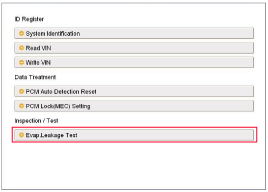
Select "Evap. Leakage Test".
|
| 2. |
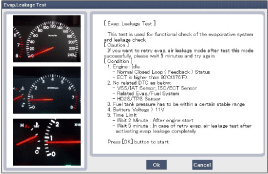
Proceed with the test according to the screen introductions.
|
 Schematic Diagrams
Schematic Diagram Canister The Canister is filled with charcoal and absorbs evaporated fuel vapor from the fuel tank. The gathered fuel vapor in canister is drawn into the intake manifold by the ECM/PCM when appropriate conditions are set...
 Canister Repair procedures
Removal 1. Turn the ignition switch OFF and disconnect the negative (-) battery cable. 2. Remove the fuel tank. (Refer to Engine Control / Fuel System - " Fuel Tank") 3...
Other information:
Hyundai Sonata LF 2014-2019 Service Manual: TPMS Receiver Description and Operation
Description 1. Mode (1) Virgin State A. The receiver as a sole part is shipped in this state. Replacement parts should therefore arrive in this state. B. In this state, there is no Auto-Location, no sensor wake-up, no sensor monitoring and no DTC monitoring...
Hyundai Sonata LF 2014-2019 Service Manual: TPMS Sensor Repair procedures
Replacement 1. Remove the tire. (Refer to Tires/Wheels - "Tire") 2. Remove the screw with torx driver (A). • When installing the bead brake, make sure that it does not come in contact with the TPMS sensor. • Be careful not to damage the TPMS sensor when installing the bead brake near the TPMS sensor...
Categories
- Manuals Home
- Hyundai Sonata Owners Manual
- Hyundai Sonata Service Manual
- Repair procedures
- Engine Mechanical System
- Brake System
- New on site
- Most important about car
