
Hyundai Sonata LF: Evaporative Emission Control System / Canister Repair procedures
Hyundai Sonata LF 2014-2019 Service Manual / Emission Control System / Evaporative Emission Control System / Canister Repair procedures
| Removal |
| 1. |
Turn the ignition switch OFF and disconnect the negative (-) battery cable. |
| 2. |
Remove the fuel tank.
(Refer to Engine Control / Fuel System - " Fuel Tank") |
| 3. |
Disconnect the vent hose (A). |
| 4. |
Disconnect the vapor tube quick-connector (B,C).
|
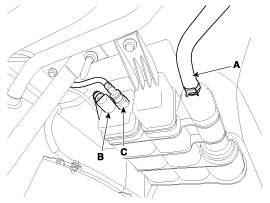
| 5. |
Remove installation bolts (A) and then remove the canister assembly.
|
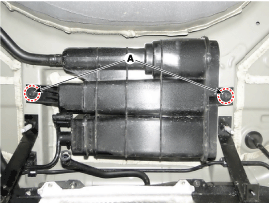
| Inspection |
| 1. |
Check for the following items visually.
A: Canister - Atmosphere
B: Canister - Fuel Tank
C: Canister - Intake Manifold
|
| Installation |
| 1. |
Install in the reverse order of removal. |
 Repair procedures
Inspection [System Inspection] 1. Disconnect the vapor hose from the intake manifold and connect a vacuum pump to the nipple on the intake manifold...
 Fuel Filler Cap Description and Operation
Description A ratchet tightening device on the threaded fuel filler cap reduces the chances of incorrect installation, which would seal the fuel filler...
Categories
- Manuals Home
- Hyundai Sonata Owners Manual
- Hyundai Sonata Service Manual
- Transmission Gear Oil General Information
- General Information
- Components and Components Location
- New on site
- Most important about car

Copyright В© 2026 www.hsonatalf.org