
Hyundai Sonata LF: Evaporative Emission Control System / Repair procedures
| Inspection |
| 1. |
Disconnect the vapor hose from the intake manifold and connect a vacuum pump to the nipple on the intake manifold.
· At Cold Engine [Engine Coolant Temperature < 60°C(140°F)]
|
| 2. |
Check the following points with applied vacuum at the purge control solenoid valve (PCSV).
· At Warmed Engine [Engine Coolant Temperature > 80°C(176°F)]
|
| 1. |
Turn ignition switch OFF and disconnect the negative (-) battery cable. |
| 2. |
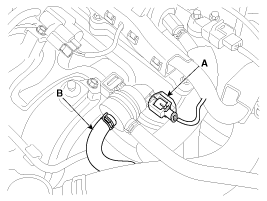
Disconnect the PCSV connector (A). |
| 3. |
Disconnect the vapor hose (B) which is connected to the intake manifold from the PCSV.
|
| 4. |
After connecting a vacuum pump to the nipple, apply vacuum. |
| 5. |
With the PCSV control line grounded, check the valve
operation with battery voltage applied to the PCSV(Open) and
removed(Closed).
|
| 6. |
Measure the coil resistance of the PCSV.
|
| 1. |
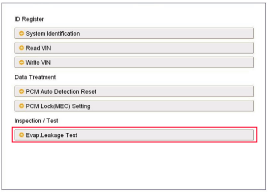
Select "Evap. Leakage Test".
|
| 2. |
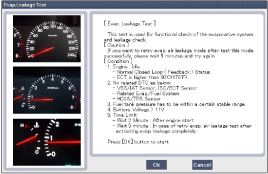
Proceed with the test according to the screen introductions.
|
 Schematic Diagrams
Schematic Diagram Canister The Canister is filled with charcoal and absorbs evaporated fuel vapor from the fuel tank. The gathered fuel vapor in canister is drawn into the intake manifold by the ECM/PCM when appropriate conditions are set...
 Canister Repair procedures
Removal 1. Turn the ignition switch OFF and disconnect the negative (-) battery cable. 2. Remove the fuel tank. (Refer to Engine Control / Fuel System - " Fuel Tank") 3...
Other information:
Hyundai Sonata LF 2014-2019 Service Manual: Warning And Caution Labels
General Information 1. Radiator cap caution2. Fan caution3. Battery caution Attention SRS VehicleThis car is equipped with a supplemental restraint system. To provide continedreliablity, certain elements of the supplemental restraint system shallbe serviced or replaced by authorized dealer ten years after vehicle label...
Hyundai Sonata LF 2014-2019 Service Manual: Components and Components Location
Components 1. Cylinder block2. Ladder frame3. Crankshaft4. Crankshaft upper bearing5. Crankshaft lower bearing6. Thrust bearing7. Main bearing cap8. External damper flywheel9. Crankshaft sproket10. Crankshaft pulley11. Water jacket insert 1...
Categories
- Manuals Home
- Hyundai Sonata Owners Manual
- Hyundai Sonata Service Manual
- Engine Electrical System
- Engine Mechanical System
- Suspension System
- New on site
- Most important about car
