
Hyundai Sonata LF: Dual Clutch Transmission Control System / Shift Cable Repair procedures
Hyundai Sonata LF 2014-2019 Service Manual / DCT (Dual Clutch Transmission) System / Dual Clutch Transmission Control System / Shift Cable Repair procedures
| Removal |
| 1. |
Remove the air cleaner assembly and air duct.
(Refer to Engine Mechnical System - "Air cleaner") |
| 2. |
Remove the TCM.
(Refer to Dual Clutch Transmission Control System - "TCM") |
| 3. |
Remove the battery and tray.
(Refer to Engine Electrical System - "Battery") |
| 4. |
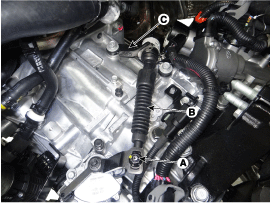
Remove the nut (A) from the manual control lever. |
| 5. |
Disconnect the shift cable (B) from the bracket (C) at transaxle side.
|
| 6. |
Remove the floor console assembly.
(Refer to Body - "Floor Consol") |
| 7. |
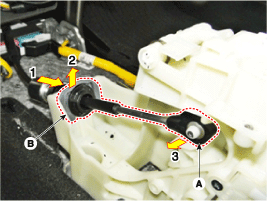
Disconnect the shift cable (A).
|
| 8. |
Remove the airbag module.
(Refer to Restraint - "Airbag Module") |
| 9. |
Disconnect the shift cable retainer (B) after removing the mounting nut (A). |
| 10. |
Remove the shift cable by pulling it toward the interior.
|

| Installation |
| 1. |
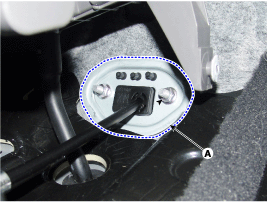
Install the shift cable retainer (A).
|
| 2. |
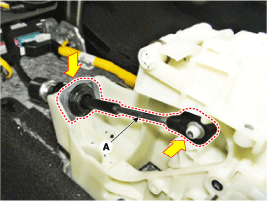
Install the shift cable (A) in the shifter lever.
|

| 3. |
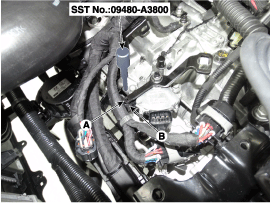
Align the hole (A) in the manual control lever with the "N"
position hole (B) of the inhibitor switch and then insert the inhibitor
switch guide pin (SST No.:09480-A3800).
|
| 4. |
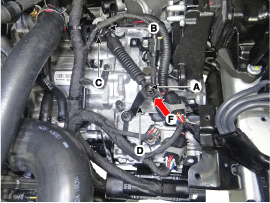
Install the shift cable (B) in the cable bracket (C). |
| 5. |
Lightly tighten the nut (A) after connected the shift cable (B) in the manual control lever (D). |
| 6. |
Push shift cable (B) lightly to "F" direction shown to eliminate free play of shift cable. |
| 7. |
Tighten the nut (A) to the specified torque.
|
| 8. |
Install the airbag module.
(Refer to Restraint - "Airbag Module") |
| 9. |
Install the floor console assembly.
(Refer to Body - "Floor Consol") |
| 10. |
Install the battery and battery tray.
(Refer to Engine Electrical System - "Battery") |
| 11. |
Install the TCM.
(Refer to Dual Clutch Transmission Control Sysmtem - "TCM") |
| 12. |
Install the air cleaner assembly and air duct.
(Refer to Engine Mechanical System - "Air cleaner")
|


 Dual Clutch System
Description and Operation Description • Components location : DCT (Dual Clutch Transmission) • Function The dual clutch is installed within the transmission...
Other information:
Hyundai Sonata LF 2014-2019 Service Manual: A/C Pressure Transducer Description and Operation
Description The A/C Pressure Transducer (APT) converts the pressure value of high pressure line into voltage value after measuring it. By converted voltage value, engine ECU controls the cooling fan by operating it high speed or low speed. Engine ECU stops the operation of the compressor when the temperature of refrigerant line is very high or very low irregularly to optimize air conditioning system...
Hyundai Sonata LF 2014-2019 Service Manual: Rear Oil Seal Components and Components Location
C..
Categories
- Manuals Home
- Hyundai Sonata Owners Manual
- Hyundai Sonata Service Manual
- Cylinder Head Cover Repair procedures
- Body Electrical System
- Engine Electrical System
- New on site
- Most important about car

Copyright © 2026 www.hsonatalf.org