
Hyundai Sonata LF: Engine Control System / RCV Control Solenoid Valve Repair procedures
| Inspection |
| 1. |
Turn the ignition switch OFF. |
| 2. |
Disconnect the RCV connector. |
| 3. |
Measure resistance between the RCV terminals 1 and 2. |
| 4. |
Check that the resistance is within the specification.
|
| Removal |
| 1. |
Turn the ignition switch OFF and disconnect the battery negative (-) terminal. |
| 2. |
Remove the air duck (A).
(Refer to Engine Mechanical System - "Air Cleaner") |
| 3. |
Disconnect the RCV control solenoid valve connector (A) and vapor hoses (B). |
| 4. |
Remove the RCV control solenoid valve (D) by loosening the mounting bolts (C).
|
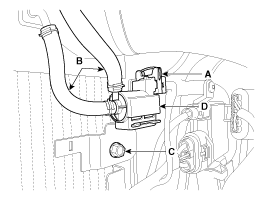
| Installation |
|

| 1. |
Install in the reverse order of removal.
|

 Fuel Pressure Control Valve Description and Operation
Description Fuel Pressure Control Valve (FPCV) is installed on the high pressure fuel pump and controls fuel flow flowing into the injectors in accordance with the ECM signal calculated based on various engine condition...
Other information:
Hyundai Sonata LF 2014-2019 Service Manual: Rear Bumper
Components and Components Location Components 1. Rear bumper cover2. Rear bumper retainer cover3. Rear bumper side bracket [LH]4. Rear bumper side bracket [RH] Rear Bumper Cover Components and Components Location Component Location 1. Rear bumper cover Rear Bumper Cover Repair procedures Replacement • Put on gloves to protect your hands...
Hyundai Sonata LF 2014-2019 Service Manual: TPMS Receiver Repair procedures
Replacement 1. Disconnect the negative (-) battery cable. 2. Remove the glove box. (Refer to Body - "Crash Pad") 3. Remove faulty part and fit bracket assembly to new part. 4. Secure new part to vehicle and fit connector. 5. Re-connect battery and turn Ignition on...
Categories
- Manuals Home
- Hyundai Sonata Owners Manual
- Hyundai Sonata Service Manual
- Cooling System
- Transmission Gear Oil General Information
- Heating, Ventilation and Air Conditioning
- New on site
- Most important about car
