
Hyundai Sonata LF: Cooling System / Thermostat Repair procedures
Hyundai Sonata LF 2014-2019 Service Manual / Engine Mechanical System / Cooling System / Thermostat Repair procedures
| Removal |
Disassembly of the thermostat would have an adverse effect, causing a lowering of cooling efficiency. |

| 1. |
Drain engine coolant so that its level would be under the thermostat height. |
| 2. |
Remove the radiator lower hose.
(Refer to Cooling System - "Radiator Hose") |
| 3. |
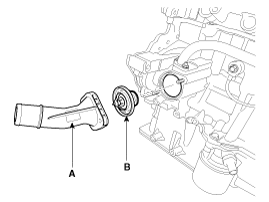
Remove the water inlet fitting (A) and thermostat (B).
|
| Inspection |
| 1. |
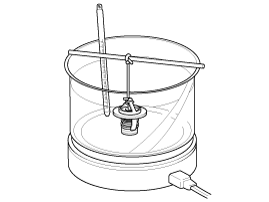
Immerse the thermostat in water and gradually heat the water.
|
| 2. |
Check the valve opening temperature.
If the valve opening temperature is not as specified, replace the thermostat. |
| 3. |
Check the valve lift.
If the valve lift is not as specified, replace the thermostat. |
| Installation |
| 1. |
Place the thermostat in the block.
Install the thermostat (B) with the jiggle valve upward. |
| 2. |
Install the water inlet fitting (A).
|
| 3. |
Fill with engine coolant. |
| 4. |
Start engine and check for leaks. |

 Thermostat Troubleshooting
Troubleshooting SymptomsPossible CausesRemedyCoolant leakage • From the thermostat gasket Check the mounting bolts • Check the torque of the mounting bolts • Retighten the bolts and check leakage again...
Other information:
Hyundai Sonata LF 2014-2019 Service Manual: Battery Repair procedures
Removal 1. Remove the air duct. (Refer to Engine Mechanical System - "Air Cleaner") 2. Disconnect the battery (-)terminal (A) and then (+)terminal (B). 3. Remove the TCM. (Refer to Automatic Transaxle System - "Transaxle Control Module (TCM)") 4...
Hyundai Sonata LF 2014-2019 Service Manual: Specifications
S..
Categories
- Manuals Home
- Hyundai Sonata Owners Manual
- Hyundai Sonata Service Manual
- Body Electrical System
- Engine Mechanical System
- DCT (Dual Clutch Transmission) System
- New on site
- Most important about car

Copyright © 2026 www.hsonatalf.org