Hyundai Sonata LF: Engine Control System / Rail Pressure Sensor (RPS) Repair procedures

Hyundai Sonata LF 2014-2019 Service Manual / Engine Control / Fuel System / Engine Control System / Rail Pressure Sensor (RPS) Repair procedures

Inspection
1.
Connect the GDS on the Data Link Connector (DLC).
2.
Measure the output voltage of the RPS at idle and various engine speed.
Condition
Output Voltage (V)
Idle
 Approx. 1.2
1,500 rpm
2.2 ~ 2.5
6,300 rpm
 Approx. 3.0

Removal
1.
Turn the ignition switch OFF and disconnect the battery negative (-) cable.
2.
Release the residual pressure in fuel line.
(Refer to Fuel Delivery System - “Release Residual Pressure in Fuel Line”)
   
When removing the fuel pump relay, a Diagnostic Trouble Code (DTC) may occur. Delete the code with the GDS after completion of “Release Residual Pressure in Fuel Line” work.
3.
Remove the intake manifold.
(Refer to Engine Mechanical System - “Intake Manifold")
4.
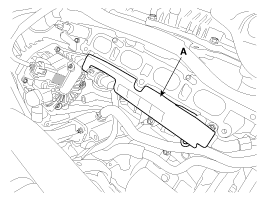
Remove the injector foam (A).

5.
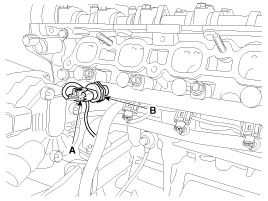
Disconnect the rail pressure sensor connector (A), and then remove the sensor (B) from the delivery pipe.

Installation
   
Install the component with the specified torques.
Note that internal damage may occur when the component is dropped. If the component has been dropped, inspect before installing.
1.
Install in the reverse order of removal.

Rail Pressure Sensor Installation:
30.0 ~ 35.0 N.m (3.0 ~ 3.6 kgf.m, 22.1 ~ 25.8 lb-ft)

    Rail Pressure Sensor (RPS) Schematic Diagrams

    C..

    Accelerator Position Sensor (APS) Description and Operation

    Description Accelerator Position Sensor (APS) is installed on the accelerator pedal module and detects the rotation angle of the accelerator pedal...

    Other information:

    Hyundai Sonata LF 2014-2019 Service Manual: Troubleshooting


    Trouble Symptom Charts Trouble Symptom 1 Trouble Symptom 2 Trouble symptomProbable causeRemedyThe set vehicle speed varies greatly upward or downward"Surging" (repeated alternating acceleration and deceleration) occurs after settingMalfunction of the vehicle speed sensor circuitRepair the vehicle speed sensor system, or replace the partMalfunction of ECMCheck input and output signals at ECM Trouble Symptom 3 Trouble symptomProbable causeRemedyThe CC system is not canceled when the brake pedal is depressedDamaged or disconnected wiring of the brake pedal switchRepair the harness or replace the brake pedal switchMalfunction of the ECM signalsCheck input and output signals at ECM Trouble Symptom 4 Trouble symptomProbable causeRemedyThe CC system is not canceled when the shift lever is moved to the "N" position (It is canceled, however, when the brake pedal is depressed)Damaged or disconnected wiring of inhibitor switch input circuitRepair the harness or repair or replace the inhibitor switchImproper adjustment of inhibitor switchMalfunction of the ECM signalsCheck input and output signals at ECM Trouble Symptom 5 Trouble symptomProbable causeRemedyCannot decelerate (coast) by using the "SET/–" switchTemporary damaged or disconnected wiring of "SET/–" switch input circuitRepair the harness or replace the "SET/–" switchMalfunction of the ECM signalsCheck input and output signals at ECM Trouble Symptom 6 Trouble symptomProbable causeRemedyCannot accelerate or resume speed by using the "RES/+" switchDamaged or disconnected wiring, or short circuit, or "RES/+" switch input circuitRepair the harness or replace the "RES/+" switchMalfunction of the ECM signalsCheck input and output signals at ECM Trouble Symptom 7 Trouble symptomProbable causeRemedyCC system can be set while driving at a vehicle speed of less than 40km/h (25mph), or there is no automatic cancellation at that speedMalfunction of the vehicle-speed sensor circuitRepair the vehicle speed sensor system, or replace the partMalfunction of the ECM signalsCheck input and output signals at ECM Trouble Symptom 8 Trouble symptomProbable causeRemedyThe cruise main switch indicator lamp does not illuminate (But CC system is normal)Damaged or disconnected bulb of cruise main switch indicator lampRepair the harness or replace the part...

    Hyundai Sonata LF 2014-2019 Service Manual: Crankshaft Position Sensor (CKPS) Troubleshooting


    Waveform This example shows a typical Crankshaft Position Sensor(CkPS) and Camshaft Position Sensor(CMPS) waveform at idle.The PCM controls the injection and ignition timing by using these signals. Generally CkPS signal is used to detect the piston's position and CMPS signal is used to detect the Top Dead Center of each cylinder...

    Categories

    read more

     
    Copyright © 2026 www.hsonatalf.org