
Hyundai Sonata LF: Crash Pad / Crash Pad Lower Panel Repair procedures
Hyundai Sonata LF 2014-2019 Service Manual / Body (Interior and Exterior) / Crash Pad / Crash Pad Lower Panel Repair procedures
| Replacement |
|

|

| 1. |
Remove the cowl side trim.
(Refer to Interior Trim - "Cowl Side Trim") |
| 2. |
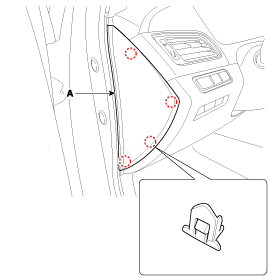
Using a screwdriver or remover, remove the crash pad side cover [LH] (A).
|
| 3. |
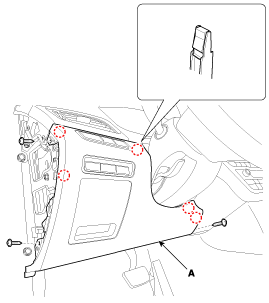
After loosening the mounting screws, then remove the crash pad lower panel (A).
|
| 4. |
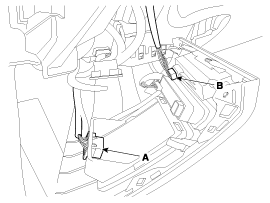
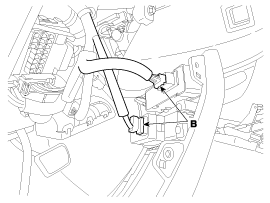
Disconnect the diagnosis connector (A) and various connectors (B).
|
| 5. |
Install in the reverse order of removal.
|


Other information:
Hyundai Sonata LF 2014-2019 Service Manual: Components and Components Location
Components Location 1. Engine Control Module (ECM) 2. Manifold Absolute Pressure Sensor (MAPS) 3. Intake Air Temperature Sensor (IATS) 4. Boost Pressure Sensor (BPS) 5. Engine Coolant Temperature Sensor (ECTS) 6. Throttle Position Sensor (TPS) [integrated into ETC Module] 7...
Hyundai Sonata LF 2014-2019 Service Manual: Refrigerant Line Components and Components Location
C..
Categories
- Manuals Home
- Hyundai Sonata Owners Manual
- Hyundai Sonata Service Manual
- DCT (Dual Clutch Transmission) System
- Engine Electrical System
- Suspension System
- New on site
- Most important about car

Copyright © 2026 www.hsonatalf.org