Hyundai Sonata LF: Rear Seat / Rear Seat Assembly Repair procedures

Hyundai Sonata LF 2014-2019 Service Manual / Body (Interior and Exterior) / Rear Seat / Rear Seat Assembly Repair procedures

Replacement
[Rear seat cushion assembly]
1.
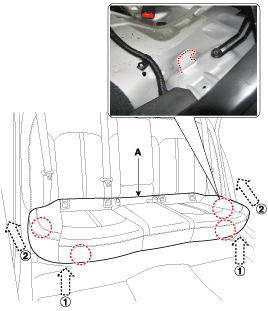
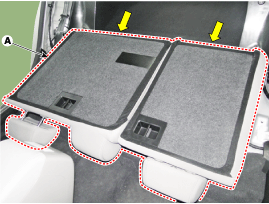
Remove the rear seat cushion assembly (A).

   
?Rear seat cushion separation method
1.
Remove the rear seat cushion by pulling upward.
2.
Remove the rear seat cushion by pulling upwards while pushing rearward.
2.
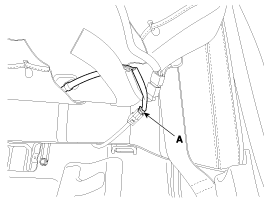
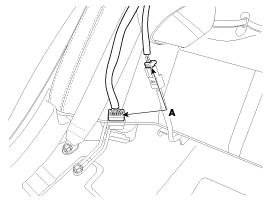
Disconnect the heater cushion connector (A).
[LH]

[RH]

3.
Install in the reverse order of removal.
   
•
Make sure the connector is connected properly.
[Rear seat back assembly]
1.
Remove the rear seat cushion assembly.
(Refer to Rear Seat - "Rear Seat Assembly")
2.
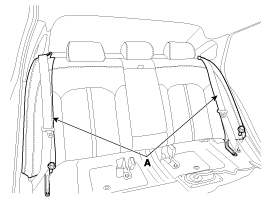
After loosening the mounting bolts, then remove the side back cover (A).

3.
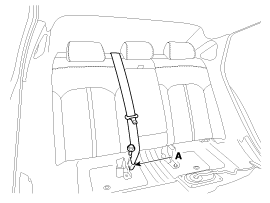
After loosening the mounting bolts, then remove the rear seat belt buckle [RH] (A).

4.
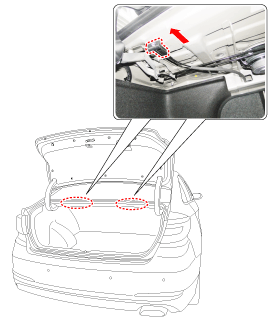
Fold the rear seat back assembly (A) by pulling the folding lever in the direction of the arrow.

5.
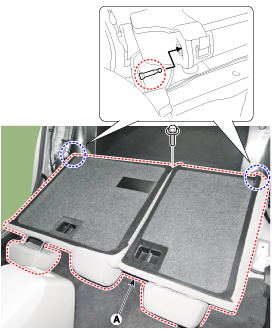
After loosening the mounting bolts, then remove the rear seat back assembly (A).

6.
Install in the reverse order of removal.

    Rear Seat Assembly Components and Components Location

    C..

    Rear Seat Back Cover Components and Components Location

    C..

    Other information:

    Hyundai Sonata LF 2014-2019 Service Manual: Description and Operation


    System Overview RPAS (Rear Parking Assist System) is an electronic driving aid that warns the driver to be cautious while parking or in low speed environments. The sensor uses ultrasonic waves to detect objects within proximity of the vehicle...

    Hyundai Sonata LF 2014-2019 Service Manual: Troubleshooting


    Trouble Symptom Charts Trouble Symptom 1 Trouble Symptom 2 Trouble symptomProbable causeRemedyThe set vehicle speed varies greatly upward or downward"Surging" (repeated alternating acceleration and deceleration) occurs after settingMalfunction of the vehicle speed sensor circuitRepair the vehicle speed sensor system, or replace the partMalfunction of ECMCheck input and output signals at ECM Trouble Symptom 3 Trouble symptomProbable causeRemedyThe CC system is not canceled when the brake pedal is depressedDamaged or disconnected wiring of the brake pedal switchRepair the harness or replace the brake pedal switchMalfunction of the ECM signalsCheck input and output signals at ECM Trouble Symptom 4 Trouble symptomProbable causeRemedyThe CC system is not canceled when the shift lever is moved to the "N" position (It is canceled, however, when the brake pedal is depressed)Damaged or disconnected wiring of inhibitor switch input circuitRepair the harness or repair or replace the inhibitor switchImproper adjustment of inhibitor switchMalfunction of the ECM signalsCheck input and output signals at ECM Trouble Symptom 5 Trouble symptomProbable causeRemedyCannot decelerate (coast) by using the "SET/–" switchTemporary damaged or disconnected wiring of "SET/–" switch input circuitRepair the harness or replace the "SET/–" switchMalfunction of the ECM signalsCheck input and output signals at ECM Trouble Symptom 6 Trouble symptomProbable causeRemedyCannot accelerate or resume speed by using the "RES/+" switchDamaged or disconnected wiring, or short circuit, or "RES/+" switch input circuitRepair the harness or replace the "RES/+" switchMalfunction of the ECM signalsCheck input and output signals at ECM Trouble Symptom 7 Trouble symptomProbable causeRemedyCC system can be set while driving at a vehicle speed of less than 40km/h (25mph), or there is no automatic cancellation at that speedMalfunction of the vehicle-speed sensor circuitRepair the vehicle speed sensor system, or replace the partMalfunction of the ECM signalsCheck input and output signals at ECM Trouble Symptom 8 Trouble symptomProbable causeRemedyThe cruise main switch indicator lamp does not illuminate (But CC system is normal)Damaged or disconnected bulb of cruise main switch indicator lampRepair the harness or replace the part...

    Categories

    read more

     
    Copyright © 2026 www.hsonatalf.org